

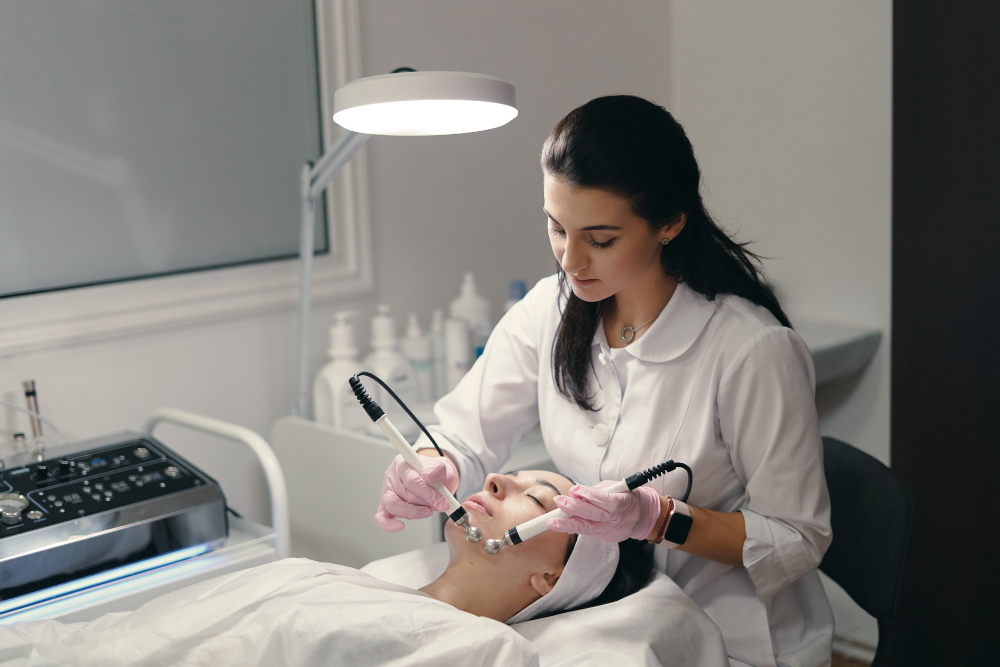
Professional pore treatments work through two mechanisms. Some stimulate new collagen so the skin around each pore tightens and supports the opening more firmly. Others resurface the skin or clear the pore so accumulated debris and thickened surface tissue no longer widen it. Laser resurfacing and radiofrequency microneedling act mainly on collagen; chemical peels and carbon laser peels act mainly on surface texture and sebum. Which is appropriate depends on skin type, pore severity, and the underlying cause.
The two things any pore treatment can change
Being precise about what these procedures do explains why some suit certain patients and not others and why the same treatment can transform one person’s skin and disappoint another’s.
A pore looks large for one of two reasons, and usually both. Either the opening is stretched and plugged, or the skin holding it has lost firmness. Clinical treatments therefore target one of two things: the surface, clearing the pore, removing thickened dead tissue, reducing oil, or the structure, rebuilding collagen and elastin so the surrounding tissue draws the opening tighter.
Neither mechanism removes a pore. Pores are permanent anatomical features and their removal would be neither possible nor desirable. What changes is how stretched and how well-supported they are, which is what determines visibility. The mechanisms that made them visible in the first place are covered in Why Do Pores Become Visible?
Collagen-stimulating treatments
Fractional laser resurfacing
Fractional lasers deliver energy in a grid of narrow columns rather than across the whole surface, deliberately leaving untreated skin between each treated zone. Those columns of controlled thermal injury trigger a wound-healing response, while the surrounding intact tissue acts as a reservoir of healthy cells that speeds recovery. This is the key design principle: treat a fraction of the area intensively rather than the whole area superficially.
The healing cascade produces new collagen over the following weeks and months, a process called neocollagenesis. As that collagen matures and organises, the dermis firms and the tissue around each pore contracts slightly, reducing the opening’s apparent width. Because this is remodelling rather than removal, improvement appears gradually and continues well after visible redness has settled — often for three to six months. Our page on fractional CO2 laser treatment describes how this modality is delivered.
Typically considered for: pore visibility driven by ageing, sun damage and laxity rather than active oiliness.
Microneedling and radiofrequency microneedling
Microneedling creates thousands of fine, controlled punctures that activate fibroblasts — the cells responsible for manufacturing collagen. The injury is mechanical rather than thermal, which is why downtime is usually shorter than with ablative lasers and why it is often better tolerated by patients who cannot accommodate a longer recovery.
Radiofrequency microneedling adds heat delivered through insulated needle tips directly into the dermis. Combining a mechanical stimulus with controlled thermal energy at depth produces a stronger tightening response while limiting disruption to the skin surface. That distinction matters clinically: because the epidermis is comparatively spared, this approach is often preferred where surface injury would carry greater pigmentation risk. Our page on micro needling RF covers how it is performed.
Typically considered for: enlarged pores alongside textural irregularity or acne scarring.
Surface and sebum-directed treatments
Chemical peels
Medical-grade peels use acids at controlled concentrations to loosen the bonds holding dead surface cells together, so they shed evenly rather than accumulating. Clearing that layer removes material that piles around pore rims and outlines them, and unclogging the pore itself allows the wall to relax back toward its resting width.
Peel depth is chosen deliberately rather than maximised. Superficial peels affect only the outermost layer with minimal downtime. Medium and deeper peels reach further and produce more change, but require correspondingly more recovery and carry more risk. Depth selection depends on skin type, tolerance, and what is driving the pore visibility, which is why it is a clinical decision rather than a menu choice.
Typically considered for: oily, congested skin where plugging is the dominant driver.
Carbon laser peel
A layer of carbon suspension is applied to the skin and allowed to settle into the pores. Laser energy is then passed across the surface. The carbon absorbs that energy strongly and is vaporised, taking adherent debris, sebum and surface dead cells with it. The heat also exerts a temporary suppressive effect on sebaceous activity.
The appeal is immediacy: skin looks refined the same day. The limitation is that the effect is largely superficial and sebum production resumes, so it is best understood as refinement and maintenance rather than structural correction.
Typically considered for: visibly oily skin with congested T-zone pores where prompt surface improvement is the goal.
Medical-grade topical therapy
Prescription-strength topicals, retinoids in particular, increase cell turnover so pores clog less readily and support collagen production over the longer term. These are generally used to extend and maintain in-clinic results rather than replace them. The specific actives and how to use them safely are covered in our guide to skincare ingredients for pore refinement.
Matching the mechanism to the cause
Because these modalities act differently, the useful question is not which treatment is best in general, but which mechanism addresses what is actually driving your pore visibility.
- Predominantly oily, congested skin — surface-directed approaches address the plugging that is stretching the pore from within.
- Age-related laxity and sun damage — collagen-stimulating approaches rebuild the support that has been lost.
- Pores accompanied by textural scarring — collagen induction addresses both concerns within one treatment course.
- Mixed presentation — combined or sequenced protocols are common, because most patients have more than one driver operating at once.
Treatments are almost always delivered as a course rather than a single session, because collagen remodelling is cumulative and each session builds on the last. The technology available continues to develop, as our overview of modern technologies for enlarged pores discusses. Skin type also shapes which approach is appropriate, which our article on skin type and enlarged pores explores.
Skin tone and treatment safety
This deserves more attention than it usually receives. Deeper skin tones carry a higher risk of post-inflammatory hyperpigmentation darkening that follows inflammation after energy-based procedures. It is generally temporary but can persist for months and is distressing when unexpected.
The risk is managed rather than eliminated: through appropriate device and wavelength selection, conservative energy settings, careful pre-treatment preparation of the skin, and strict sun protection afterwards. This is why settings validated for one skin type cannot simply be transferred to another, and why treatment selection should be made by a practitioner experienced with your particular skin type rather than chosen from a list of options.
Aftercare determines how much of the result you keep
Because these procedures work by triggering a healing response, what happens afterwards materially affects the outcome. Sun protection is the single most important factor, since fresh UV exposure degrades the very collagen the treatment was intended to build. Supporting the barrier while it recovers, avoiding active exfoliants until the skin has settled, and following the prescribed regimen all contribute. Our article on improving skin texture after pore treatment covers the post-treatment phase in detail.
How long results last, and what maintenance realistically involves, is addressed in Can Open Pores Be Permanently Reduced?
Frequently asked questions
How do lasers reduce pore size if pores cannot be removed?
They do not remove the pore. They stimulate collagen in the surrounding dermis so the tissue holds the opening more tightly, which reduces how visible it is.
Why are several sessions usually needed?
Collagen remodelling happens gradually and accumulates with each treatment. A single session produces a partial response; a course allows the effect to build.
Is microneedling or laser more effective for pores?
Neither is universally better. Lasers tend to suit sun damage and laxity; microneedling suits texture and scarring alongside pores. The right choice depends on the driver and the skin type.
Are these treatments painful?
Discomfort varies by modality and depth. Topical anaesthetic is commonly used for microneedling and laser procedures, and most patients describe the sensation as tolerable rather than painful.
Can different treatments be combined?
Yes, and combined protocols are common where more than one mechanism is driving pore visibility. Sequencing and the interval between treatments are decided clinically.
How soon after treatment can I wear makeup?
This depends entirely on the modality and depth used. Your practitioner will give specific guidance, and following it matters applying products to skin that is still recovering can compromise both healing and the result.
Getting an assessment
Which mechanism applies to your skin, and therefore which treatment is appropriate, depends on your skin type, the cause of your pore visibility and how much downtime you can accommodate. None of these can be judged from photographs or a description. You can read about the open pores treatments offered at our clinic and how a skin assessment is arranged.