

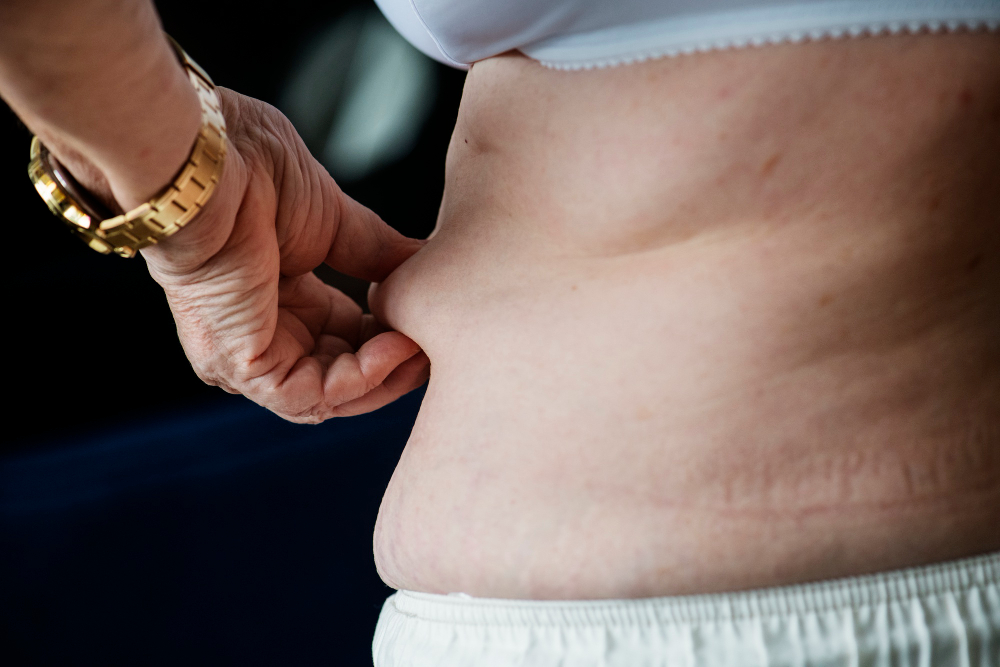
Liposuction removes fat but does not tighten skin. After the fat is taken away, the skin has to shrink back into the smaller contour on its own. Whether it does so smoothly depends mainly on skin elasticity, the volume of fat removed, the patient’s age and the condition of the skin beforehand. Patients with firm, elastic skin usually see it retract well over three to six months. Patients whose skin has already lost elasticity may be left with looseness that liposuction alone cannot correct.
Why liposuction does not tighten skin
It helps to picture what the procedure actually does. Liposuction targets the layer of fat sitting between the skin and the muscle. A thin cannula is passed through that layer, the fat is loosened and suctioned away, and the space it occupied closes down. The skin above is not cut, lifted or removed.
That means the skin has one job afterwards: to contract into the smaller shape underneath. Skin is elastic tissue, and elastic tissue recovers well when its elastic fibres are intact. When they are not, the skin behaves more like fabric that has been stretched permanently out of shape.
This is why two patients can have the same amount of fat removed from the same area and end up with visibly different results. The variable is not the surgery. It is the skin.
What determines whether your skin will retract
Skin elasticity
Elasticity is the single most important factor. Skin rich in collagen and elastin springs back readily. As those proteins decline, the capacity to retract declines with them. A surgeon assesses elasticity during examination, typically by gently pinching and releasing the skin to see how quickly it returns to position.
Age
Younger patients generally have more elastic skin and see faster, more complete retraction. Age is not an absolute barrier; many older patients have excellent skin quality, but it shifts the odds.
Volume of fat removed
The more fat that is taken out, the more the skin has to contract to keep up. Removing a modest amount from an area with good skin quality is low-risk. Removing a large volume from an area where the skin is already borderline increases the chance of looseness afterwards.
Skin history
Skin that has been stretched substantially in the past through significant weight fluctuation, pregnancy, or prolonged obesity is more likely to have sustained damage to its elastic fibres. Sun damage and smoking also degrade collagen over time.
Treatment area
Some regions retract more reliably than others. The neck and jawline often respond well. The upper arms and inner thighs are more challenging, because the skin there is thinner and less well supported.
How long does skin take to tighten after liposuction?
Skin retraction is gradual. Most of the visible change happens over the first three months, and the process typically continues for around six months as residual swelling resolves and the tissue settles. Judging your final skin result before roughly the six-month mark is premature.
This timeline matters emotionally as much as clinically. In the early weeks, the treated area is swollen, which can temporarily disguise looseness and then, as the swelling subsides, patients sometimes feel their skin looks worse before it looks better. That phase is normal and is not, on its own, evidence of a poor outcome.
Our article on how long liposuction takes to heal sets out the wider healing timeline that this sits within.
Can loose skin be prevented?
Partly, and mostly before surgery rather than after.
The most effective prevention is honest candidate selection. A surgeon who identifies poor skin elasticity during assessment can plan differently: removing a more conservative volume of fat, staging treatment, or recommending a different procedure altogether. A surgeon who ignores it and removes fat aggressively is the most common route to a disappointing skin result.
Beyond selection, the factors within a patient’s control are the ordinary ones: reaching a stable weight before surgery rather than expecting the procedure to substitute for weight loss, not smoking, protecting the skin from sun damage, and staying well hydrated. None of these transforms poor elasticity into good elasticity, but they support the tissue’s capacity to recover.
Wearing the compression garment exactly as instructed also matters. Compression supports the tissue while it settles and helps the skin adhere smoothly to the contour beneath rather than healing in a lax position.
What if the skin will not retract enough?
When a surgeon judges that skin quality is insufficient for liposuction alone to give a good result, the honest answer is that a different or additional procedure is needed. Removing fat under loose skin without addressing the skin generally makes the looseness more obvious, not less.
The usual alternative is a skin-excision procedure that removes the excess skin itself rather than only the fat beneath it. For the abdomen, that is an abdominoplasty. Our comparison of liposuction and tummy tuck surgery explains how the two differ in what they can achieve.
For patients who have lost a large amount of weight and have loose skin across several regions, a broader approach may be appropriate. Our page on post-weight-loss body contouring covers that situation.
It is worth saying plainly: being told you need a skin-removal procedure rather than liposuction is not bad news dressed up. It is the difference between a result you are happy with and one you are not.
Do energy-assisted techniques help?
Some liposuction technologies deliver energy into the tissue as well as removing fat, and these are often described as offering a degree of skin tightening. Laser-assisted and ultrasound-assisted systems fall into this category, and there is a reasonable clinical rationale: the energy can stimulate a tightening response in the surrounding tissue.
The important caveat is one of degree. Any tightening effect from these devices is modest. It can improve an outcome at the margins for a patient whose skin quality is already reasonable. It does not substitute for skin excision in a patient with significant laxity, and it should not be presented as though it does.
If you want to understand how the different systems work, our overview of liposuction techniques and how they differ covers each one.
Assessing your own risk before surgery
You cannot reliably assess your own skin elasticity, and online quizzes and pinch tests are not a substitute for examination. What you can do is arrive at a consultation prepared to ask directly: Given my skin quality, what is the realistic result? Am I at risk of looseness? Would you recommend a different procedure?
A surgeon who answers those questions specifically, and who is willing to advise against liposuction where it is not appropriate, is giving you the information you need. Our guide on what makes someone a suitable liposuction candidate covers the criteria a surgeon weighs.
Frequently asked questions
Does liposuction always leave loose skin?
No. Most patients with good skin elasticity see the skin retract smoothly. Looseness is a risk in specific circumstances: poor elasticity, large-volume removal, previously stretched skin rather than a routine outcome.
Will my skin tighten on its own after liposuction?
It will retract to the extent its elasticity allows, over roughly three to six months. Skin with intact elastic fibres does this well. Skin that has lost elasticity will not regain it through healing alone.
Can I do anything to tighten skin after liposuction?
Wearing compression as directed, maintaining a stable weight, staying hydrated, and avoiding smoking all support the process. None of these will resolve significant laxity, which usually requires a surgical solution.
Is loose skin after liposuction permanent?
If it is still present after the tissue has fully settled, it is unlikely to improve further on its own. At that point, the options are to accept it or to consider a skin-removal procedure.
Am I too old for liposuction because of my skin?
Age alone does not disqualify anyone. Skin quality matters more than the number, and that has to be assessed individually by a qualified plastic surgeon.
Does losing weight before liposuction reduce the risk?
Being at a stable weight beforehand generally produces a better and more predictable result. Large weight loss after surgery can itself leave skin loose, because the skin then has to contract further.
Getting a realistic assessment
Skin quality is the part of a liposuction result that cannot be judged from photographs or described accurately over the phone. It needs hands-on examination. If you would like your own skin assessed and an honest view of what liposuction would and would not achieve for you, our liposuction page for Hyderabad patients explains how to arrange a consultation.