

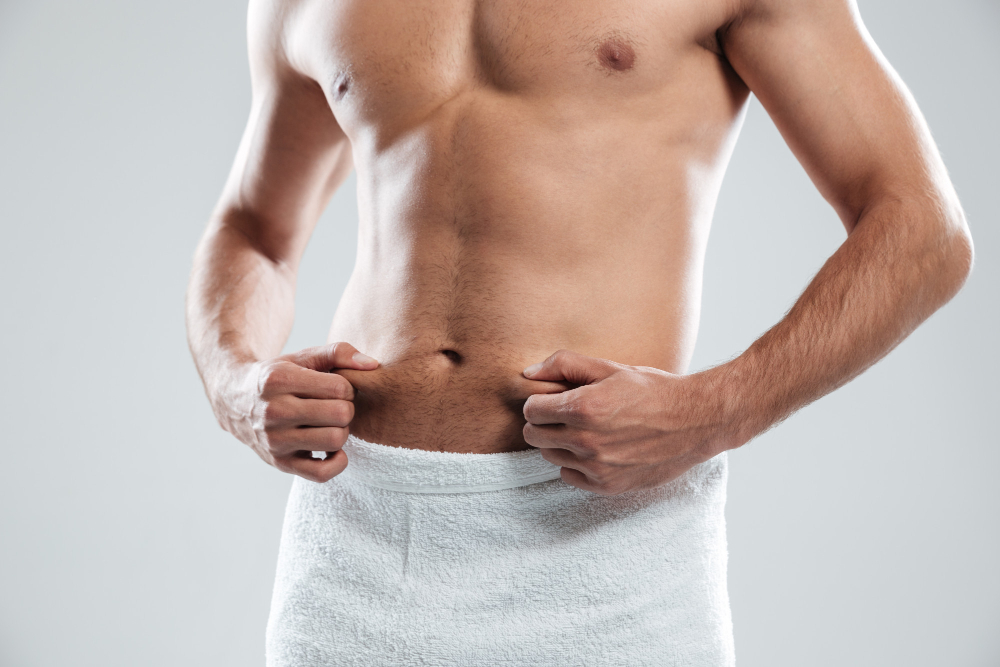
Yes. Liposuction is performed on men as well as women, and male patients make up a meaningful share of body contouring procedures worldwide. The technique is the same in principle: fat is loosened and suctioned out through small incisions but the goals differ. Male liposuction usually aims to define existing muscle structure and flatten the torso rather than create curves. The most commonly treated male areas are the abdomen, flanks, chest and neck.
Why men and women are treated differently
Fat does not sit in the same places, or behave the same way, in male and female bodies. Men tend to store fat around the abdomen, flanks and chest, and that fat is often more fibrous and densely attached to surrounding tissue than the softer subcutaneous fat more common in female hips and thighs. Fibrous fat is harder to break up, which influences the technique a surgeon selects and the time a procedure takes.
The aesthetic goal is different too. In female body contouring, the surgeon is frequently working toward a smooth, curved silhouette. In male contouring, the aim is usually the opposite: a flatter abdomen, a narrower waistline, a firmer chest and visible definition along the natural lines of the muscles underneath. That means fat is not simply removed in bulk it is removed selectively, with more left behind in some places than others.
Because of this, a surgeon planning male liposuction is thinking about muscle anatomy as much as fat volume. The underlying structure has to be worth revealing before revealing it makes sense.
Which areas of the male body are most commonly treated
Abdomen and flanks
The abdomen and the flank, the fat pads sitting over the sides of the torso, often called love handles are the two most requested male areas. They are also the areas most resistant to diet and exercise in men, which is why they remain after weight loss elsewhere has succeeded. Treating the abdomen and flanks together is common, because reducing one without the other can leave an uneven transition around the waistline.
Chest
Excess male chest tissue is a frequent reason men seek surgical advice. This is where an important distinction matters, and it is covered in its own section below.
Neck and jawline
Submental fat under the chin blurs the jawline and can make a man look heavier than he is. Because the area is small and the skin is relatively thin, it responds well to precise fat removal, and results are visible in photographs and on video calls in a way that torso work is not.
Back and upper arms
Fat across the upper back and along the bra-line area is treated less often but responds reasonably well. Upper arm treatment in men is usually focused on reducing bulk rather than reshaping.
If you want a broader view of how these regions are approached and which techniques suit which tissue type, our overview of the different liposuction techniques explains the differences in plain terms.
Male chest fat is not always just fat
Enlarged male breast tissue can be caused by fat, by glandular breast tissue, or by both. Liposuction removes fat effectively but does not remove firm glandular tissue on its own. Where glandular tissue is present, surgical excision is usually required alongside liposuction.
This is the single most important thing for a man researching chest surgery to understand. Gynecomastia is a medical condition involving the growth of glandular breast tissue, and it feels different from fat — firmer, more rubbery, and typically concentrated directly behind the nipple. Pseudogynecomastia describes chest enlargement caused by fat alone.
Telling the two apart is a clinical assessment, not something that can be judged reliably from photographs or self-examination. Many patients have a combination of both, in which case a surgeon may use liposuction to reduce the fatty component and address the glandular component separately in the same operation.
If chest contouring is your main concern, our dedicated page on gynecomastia surgery covers that procedure specifically.
High-definition contouring and abdominal etching
Some men ask about the sculpted, athletic look sometimes described as high-definition liposculpture or abdominal etching. These are advanced applications of liposuction in which fat is removed at different depths to emphasise the natural grooves between abdominal muscles and along the edges of the chest.
Ultrasound-assisted systems such as VASER are often used for this work, because ultrasound energy can break up fibrous fat while being gentler on surrounding structures than purely mechanical methods. That said, high-definition work is not a shortcut to an athletic physique. It reveals structure that already exists. A patient carrying significant fat, or with limited muscle development underneath, will not achieve a defined result no matter how the fat is removed — and attempting it can produce an unnatural, over-sculpted appearance that is difficult to correct.
A conservative, softer definition usually ages better and looks more natural than aggressive etching.
Who is a suitable male candidate?
Suitability is assessed individually, but the broad principles are consistent. Liposuction is a contouring procedure, not a weight-loss treatment, and it works best for men who are already reasonably close to a stable weight and who have localised fat that has not responded to sustained diet and exercise.
Skin quality matters as much as fat volume. When fat is removed, the skin above it has to retract into the new contour. Skin with good elasticity does this well; skin that has been stretched over many years, or that has lost elasticity with age, may not. Being a non-smoker, in general good health, and having realistic expectations all form part of the assessment.
Our guide on who makes a good candidate for liposuction the criteria in more detail. Whether they apply to you specifically is something only a qualified plastic surgeon can determine after an in-person examination.
What recovery looks like for male patients
Recovery follows the same broad pattern regardless of sex. Swelling and bruising are expected, a compression garment is worn to support the tissue and control swelling, and most patients return to desk-based work within about a week. Strenuous exercise and heavy lifting are restricted for longer, typically several weeks, on the surgeon’s advice.
There is one practical difference worth planning for. Men treated on the abdomen, flanks or chest are often keen to return to gym training, and this is precisely the activity that needs the most patience. Resuming resistance training too early risks swelling, fluid collection and a compromised result. Fat removal is permanent, but the final contour takes months to settle as residual swelling resolves.
Our article on practical steps for a smoother liposuction recoverycovers the aftercare that makes the biggest difference.
Will the result last?
The fat cells removed during liposuction do not grow back. What can change is the size of the fat cells that remain. If a patient gains significant weight afterwards, those remaining cells enlarge, and the body may also store more fat in untreated areas. Men who maintain a stable weight after surgery generally retain their result well over the long term.
Frequently asked questions
Is liposuction common for men?
Yes. Male body contouring is a well-established part of plastic surgery practice, and the chest, abdomen and flanks are among the most frequently treated male areas.
Can liposuction alone fix man boobs?
Only if the enlargement is caused by fat. If firm glandular breast tissue is present, that tissue generally has to be removed surgically, because liposuction is not designed to extract it.
Will liposuction give me visible abs?
Liposuction can reveal muscle definition that already exists beneath the fat. It cannot create muscle. Men without developed abdominal musculature will see a flatter torso rather than visible definition.
How soon can I go back to the gym after liposuction?
Light walking is usually encouraged early to support circulation, but resistance training and high-intensity exercise are restricted for several weeks. Your surgeon will set the timeline based on how much fat was removed and from where.
Is male liposuction more difficult than female liposuction?
It is not harder so much as different. Male fat is often more fibrous, which can require more energy-assisted technique, and the aesthetic goal involves definition rather than smoothing.
Does liposuction help with a double chin in men?
Fat under the chin responds well to treatment in suitable patients. Skin elasticity in the neck is an important factor in the final result.
Talking to a surgeon
Whether liposuction is appropriate for you, which areas would benefit, and whether your chest concern is fatty or glandular are all questions that need a physical examination rather than online research. If you are considering treatment and want your own case assessed, our page on liposuction surgery in Hyderabad explains how consultations are arranged and what the procedure involves at our clinic.